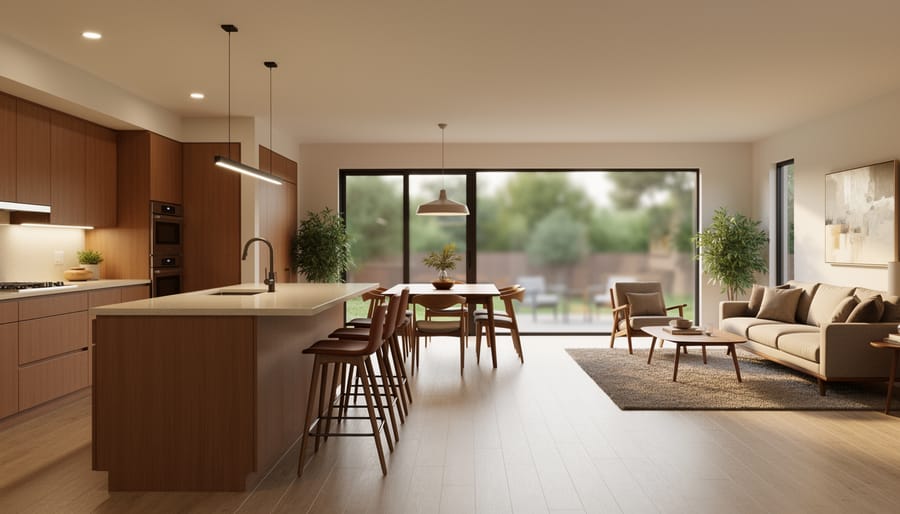
Opening up a ranch house with a floor plan redesign typically removes walls between the kitchen, dining, and living areas to create one continuous space, a transformation that usually costs between $5,000 and $25,000 depending on whether you’re removing load-bearing walls. The single-story layout of ranch homes makes them ideal candidates for this renovation because you’re working with predictable structural systems and uniform ceiling heights throughout, unlike multi-level homes where floor joists and support become more complex.
If you bought a ranch built between the 1950s and 1980s, chances are you’re living with a series of closed-off rooms that feel cramped and dark. That was the design standard back then. What made sense for formal entertaining and defined spaces doesn’t match how most families actually live today. We gather in the kitchen, we want to see the kids while cooking dinner, and we need rooms that flex between daily chaos and weekend hosting.
The good news? Ranch architecture works beautifully with open concepts because these homes were built on concrete slabs or crawl spaces with exterior load-bearing walls, meaning many interior walls are simply partitions. That doesn’t mean every wall can go, though. You’ll need to identify load-bearing walls, budget for beam installation if required, and plan around plumbing and electrical that might be hidden inside those walls.
This guide walks you through everything from the initial structural assessment to design strategies that keep your newly open space from feeling like an echo chamber. You’ll learn which professionals to call first, what permits you actually need, and how to maintain distinct zones without putting the walls back up.
The Ranch House DNA: Why Open Layouts Feel So Natural
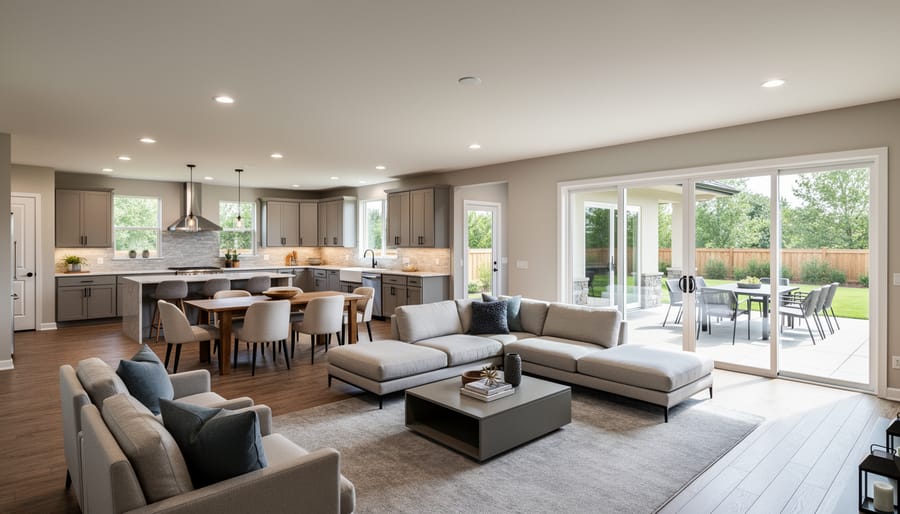
Ranch homes weren’t designed with open floor plans in mind back in the 1940s and 50s, but it turns out their DNA practically begs for it. The architectural bones of a typical ranch house align remarkably well with modern open-concept living, which is why this renovation feels less like forcing a square peg into a round hole and more like revealing what was always meant to be.
The single-story layout is the first advantage. Without stairs dividing your home into separate levels, you’re already working with one continuous plane. There’s no upstairs-downstairs separation to contend with, which means opening up walls creates true flow rather than just connecting spaces that still feel disconnected. Everything happens on the same level, making it easier for families to stay connected and for sight lines to extend across multiple areas.
Ranch architecture also emphasizes horizontal lines and low-pitched rooflines that naturally draw the eye across spaces rather than up. This horizontal orientation complements open layouts beautifully because both concepts prioritize width and breadth over vertical division. When you remove a wall between your kitchen and living room, you’re enhancing what the architecture already suggests.
Several features make ranch homes particularly well-suited for open plans:
- Large windows and sliding glass doors that already connect interior spaces to outdoor views
- Simple rectangular or L-shaped footprints without complicated angles or multiple wings
- Centrally located living areas that can easily become the heart of an open layout
- Modest overall square footage that benefits from the spaciousness an open plan creates
- Post-and-beam construction in many mid-century ranches, with fewer load-bearing interior walls
The original mid-century design philosophy behind ranch homes also favored casual living and indoor-outdoor connection. These houses were built for a more relaxed, less formal lifestyle than their Victorian or Colonial predecessors. Many ranch floor plans already featured semi-open kitchens with pass-throughs or breakfast bars, hinting at the open concept without fully committing to it. Opening up these spaces completely just takes that 1950s philosophy to its logical conclusion.
Even the typical ceiling height in ranch homes, usually around eight feet, works in your favor. While that might feel low in a chopped-up floor plan, an open layout allows the eye to travel horizontally across a larger expanse, making the space feel more generous despite the lower ceilings.
The Real Benefits of Opening Up Your Ranch Home
Opening up a ranch home delivers benefits that go beyond just following a trend. The single-story layout amplifies every advantage of open space, creating real improvements in how your home functions day to day.
The sight line advantage matters more than most people realize until they experience it. Parents cooking dinner can watch kids doing homework at the dining table or playing in the living room without shouting through doorways or craning around corners. One homeowner described it perfectly: “I finally stopped feeling like I was missing out on family time just because I was in the kitchen.” That continuous visual connection reduces the isolation that closed-off kitchens create, especially in homes where the kitchen was tucked away as a purely utilitarian space.
Natural light becomes a shared resource rather than a room-by-room lottery. Ranch homes typically have windows on multiple exterior walls, but traditional layouts trapped that light in individual rooms. Remove a wall or two, and sunlight from south-facing living room windows suddenly reaches into a darker kitchen. Morning light from an east bedroom hallway spills into the main living area. You’ll notice the difference on your electric bill and in your mood, particularly during shorter winter days.
The entertaining factor transforms completely. Ranch homes often have modest square footage, usually between 1,200 and 1,800 square feet. Closed floor plans made gatherings feel cramped, with guests clustering in the kitchen while the living room sat empty. An open layout lets twenty people spread naturally across connected spaces without anyone feeling stuck in a corner. The cook stays part of the conversation instead of banished to a separate room. Holiday dinners, game nights, and casual get-togethers all flow better.
Perhaps the most dramatic change is the perception of space. A 1,400-square-foot ranch with three separate boxes for kitchen, dining, and living feels tight and chopped up. That same square footage opened up suddenly feels generous. Your eye travels across the entire main living area instead of stopping at a wall eight feet away. Real estate agents know this effect well, open ranch homes photograph larger and show better than compartmentalized ones with identical square footage.
You’re not actually gaining space, but you’re gaining the experience of space, which matters just as much for how your home feels every single day.
Which Walls Can Actually Come Down? A Homeowner’s Primer
Before you start dreaming about your new open kitchen-living space, you need to know one critical thing: not every wall in your ranch can come down safely. The good news? Ranch homes actually make this determination somewhat easier than multi-story houses.
Understanding Load-Bearing Walls in Ranch Construction
In a typical ranch home, load-bearing walls run perpendicular to your ceiling joists and support the roof structure above. Since ranch homes are single-story, you’re usually dealing with a simpler structural system than a two-story house. The exterior walls always bear weight. Interior walls that run down the center of your home often do too, especially if they align with the roof ridge.
Here’s a quick visual test: go into your attic or crawl space if you can access it. Look at which direction your roof joists run. Any wall that sits directly beneath where joists meet or change direction is likely load-bearing. Walls that run parallel to the joists typically aren’t carrying structural weight.
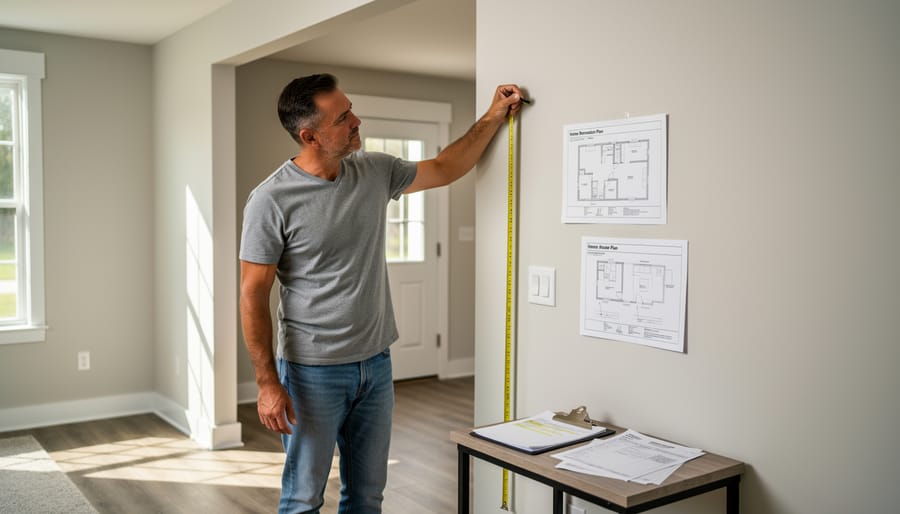
That said, this is educated guessing at best. Never remove a wall based on a DIY assessment alone.
When You Absolutely Need Professional Help
You need a structural engineer or licensed contractor before touching any wall you suspect might be load-bearing. Period. An engineer’s inspection typically costs between $500 and $800 in most markets for 2026, and it’s the best money you’ll spend on your project. They’ll provide stamped drawings showing exactly what support beam you need, what size, and how it should be installed.
If your ranch was built before 1980, also consider having an asbestos test done on any walls you’re planning to remove. Many older drywall compounds and insulation materials contain asbestos, which requires specialized removal.
The Permit Process Demystified
Removing a load-bearing wall requires a building permit in virtually every jurisdiction. Your contractor or engineer can usually handle the permit application, or you can file it yourself with their stamped drawings. The process typically takes two to four weeks for approval, though timelines vary by municipality.
Non-load-bearing wall removal often doesn’t require permits, but check your local building department’s requirements. Some cities want permits for any structural changes, even cosmetic ones.
Real-World Costs for 2026
Budget $1,500 to $3,000 for removing a simple non-load-bearing wall, including drywall removal, debris hauling, and patching floors and ceilings. For load-bearing walls, expect $3,500 to $10,000 depending on span width and beam requirements. A basic steel beam installation for a 12-foot opening typically runs $4,000 to $6,000 including labor.
These figures don’t include refinishing work like flooring transitions, electrical modifications, or HVAC adjustments, which can add another $2,000 to $5,000 to your total project cost.
Popular Ranch Open Floor Plan Configurations
The beauty of opening up a ranch home is that you’re not reinventing the wheel, you’re working with layouts that thousands of homeowners have tested and refined. Let’s look at the configurations that consistently deliver the best results.
The kitchen-living-dining combination remains the gold standard for ranch open floor plans. This layout removes walls between all three spaces, creating one continuous room that typically spans 500-800 square feet. You’ll cook, entertain, and eat in clear sight of each other, which makes family life easier and gatherings more inclusive. The key is positioning your kitchen along one wall or in an L-shape, leaving the center open for traffic flow between the living and dining zones.
Great room concepts take a different approach by merging your living room with other spaces while keeping the kitchen semi-separated. You might open the wall between living and dining rooms completely, then add a large pass-through or peninsula to connect the kitchen. This works beautifully if you want openness but prefer to hide kitchen cleanup during dinner parties. The great room becomes your home’s heart, with the kitchen playing a supporting role rather than center stage.
The kitchen-family room merger appeals to families who spend most of their time in these two spaces. You remove the wall between them but leave the formal dining room intact as a separate space. This gives you the casual, connected feel where it matters most while maintaining a quieter room for homework, home offices, or traditional holiday meals.
| Configuration | Best For | Main Advantage | Watch Out For |
|---|---|---|---|
| Kitchen-Living-Dining | Frequent entertainers, open lifestyle | Maximum openness and light | Kitchen always on display |
| Great Room Concept | Those wanting some kitchen separation | Hides kitchen mess when needed | Requires smart peninsula design |
| Kitchen-Family Room | Families prioritizing casual living | Keeps formal dining private | May feel disconnected from dining |
Traffic flow deserves careful thought in any configuration. Create clear pathways at least 36 inches wide between functional zones. Avoid layouts that force people to walk behind someone cooking or between the TV and seating area. The best ranch open floor plans let you move from the front door to the kitchen, from the kitchen to the backyard, and through the living space without cutting through conversation areas or work zones.
Functional zones matter even without walls. Position your sofa to define the living area boundary. Use your dining table placement to claim that space. Let your kitchen island create a natural edge for the cooking zone. These invisible boundaries keep your open space from feeling like one big, undefined room where nothing has a clear purpose.
Design Strategies That Make Open Ranch Floor Plans Work
Opening up your ranch home creates wonderful flow, but without walls, you need intentional design strategies to keep the space from feeling like one giant room. The goal is creating distinct zones that still feel connected, and you can do this beautiarily with a few smart techniques.
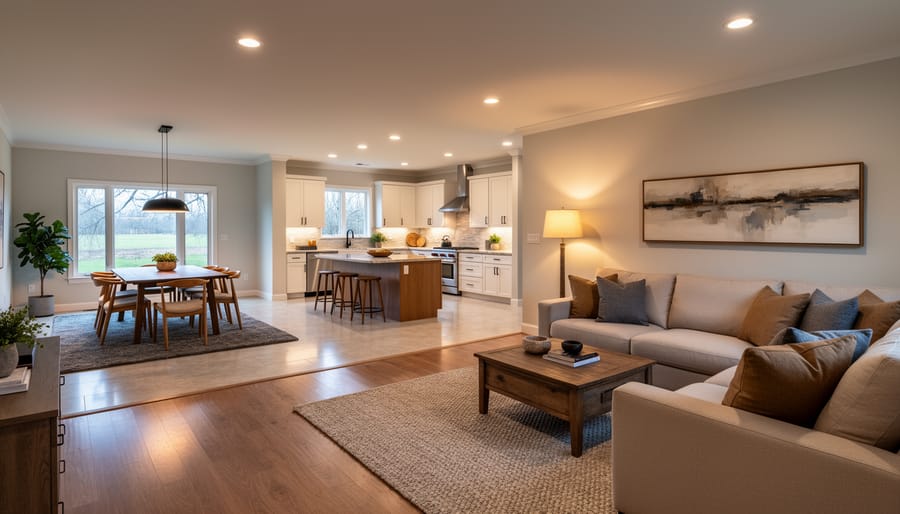
Start with furniture arrangement as your primary room definer. Float your sofa away from the wall to anchor the living area, positioning it perpendicular to the kitchen rather than against a wall. This creates an implied boundary without blocking sight lines. A console table behind the sofa adds function while reinforcing that invisible line. In the dining zone, center your table under a statement light fixture to establish its own territory within the larger space.
Area rugs are your best friend for visual zoning. Place a large rug under your living room seating to ground that area, then use a different rug under the dining table. The rugs don’t need to match perfectly, but they should coordinate. This simple trick tells your brain “you’ve entered a different space” without any physical barriers. Make sure your rugs are large enough, all furniture legs should fit on the rug, or at least the front legs.
Lighting creates powerful invisible boundaries. Install different light sources for each zone rather than relying on overhead fixtures alone. Pendant lights over the kitchen island, a chandelier over the dining table, and table lamps flanking the sofa give each area its own atmosphere. Put them on separate switches or dimmers so you can adjust the mood for different activities happening simultaneously.
Ceiling treatments add definition from above. Consider exposed beams over the living area, a tray ceiling in the dining space, or shiplap in the kitchen zone. Even painting the ceiling different colors in each area works, keeping them all in the same family maintains cohesion while providing subtle separation. Ranch homes typically have lower ceilings (around eight feet), so these treatments add interest without feeling heavy.
Flooring transitions mark territory effectively. Tile or luxury vinyl in the kitchen, hardwood or laminate in living and dining areas creates natural boundaries. If you’re keeping the same flooring throughout, change the direction of plank installation between zones or use a border pattern where areas meet.
Paint color can zone spaces while maintaining flow. Paint your kitchen cabinets or island a different color than the living area walls. Or use the same color in different sheens, matte in living spaces, semi-gloss in the kitchen. An accent wall behind the dining table or TV creates a focal point that defines that zone’s purpose.
The trick is layering several of these strategies together. Use a rug plus lighting plus furniture arrangement, not just one element. This redundancy ensures your zones feel intentional and lived-in rather than arbitrary.
Solving the Common Challenges
Opening up your ranch house creates beautiful flow, but it also introduces challenges that walls used to handle. Here’s how to solve the most common issues homeowners face.
Noise travels everywhere. Without walls to absorb sound, conversations in the kitchen carry straight to the living room, and the TV competes with the dishwasher. Start with soft furnishings, upholstered furniture, thick area rugs, and curtains all dampen sound naturally. Add acoustic panels disguised as wall art in key spots. Consider a sound-absorbing ceiling treatment in your main gathering area. If noise remains problematic, a partial wall or floor-to-ceiling bookshelf can work as a sound barrier without closing off the space entirely.
Heating and cooling becomes less efficient. One large open space is harder to temperature-control than divided rooms. Ceiling fans become essential, not decorative. Install them strategically to circulate air throughout the entire space. A smart thermostat with multiple sensors helps balance temperatures between zones. If your HVAC system struggles, adding zone controls or upgrading to a variable-speed system prevents one end of the house from being too hot while the other freezes. Close off vents in less-used areas to redirect airflow where you need it most.
Privacy disappears when you need it. Someone’s always watching TV while you’re trying to read, or guests linger in the living room when you want to clean up the kitchen. Sliding barn doors or pocket doors offer privacy on demand without permanently dividing the space. Room dividers, tall plants, or strategically placed bookcases create visual separation when you need it. Consider how furniture arrangement can create semi-private zones, positioning a sofa to face away from the kitchen naturally separates the spaces.
The kitchen mess becomes everyone’s problem. Dirty dishes and food prep clutter are now on full display. A large kitchen island with a raised bar section hides countertop chaos from the living area while maintaining openness. Deep drawers and hidden storage keep appliances out of sight. Make cleanup part of your routine before settling into the living space. If visibility really bothers you, consider a butler’s pantry or scullery for messy prep work.
Furniture placement feels impossible. Without walls to anchor furniture, everything floats awkwardly. Define conversation areas by arranging seating in clusters rather than pushing everything against walls. Use area rugs to ground each zone. Face furniture toward focal points like fireplaces or windows, not just the TV. Leave clear pathways between zones, typically three feet minimum, so the space feels open rather than crowded.
These challenges have straightforward solutions once you identify which ones affect your daily life most.
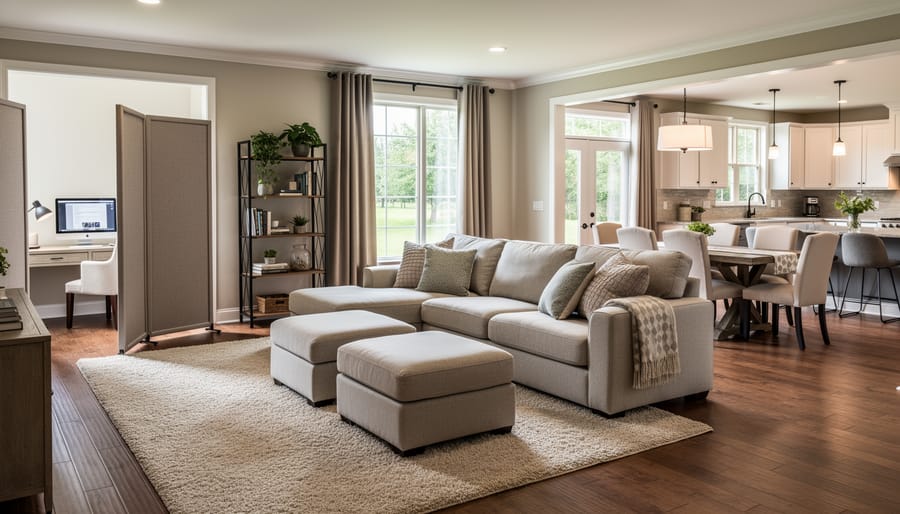
DIY-Friendly Updates vs. When to Call the Pros
Not every aspect of opening up your ranch floor plan requires a contractor’s expertise or a massive budget. Understanding where you can confidently DIY and where professional help is non-negotiable protects both your safety and your investment.
Projects You Can Tackle Yourself
Several changes create openness without touching structural elements. Removing upper kitchen cabinets instantly opens sight lines between the kitchen and adjacent rooms, and it’s a weekend project with basic tools. Updating lighting with modern pendant fixtures or recessed LED cans (surface-mounted versions) changes how spaces feel without rewiring. Painting walls in a consistent color palette throughout connected areas enhances flow, as does installing uniform flooring transitions or area rugs to define zones without barriers.
Furniture rearrangement costs nothing but time. Floating your sofa away from walls, using open-back shelving as room dividers, and choosing lower-profile pieces all contribute to an airier feel. Replacing solid doors with glass-paneled or barn-style options maintains privacy while borrowing light between spaces.
When Professionals Become Essential
Anything structural demands expert involvement. Removing or modifying walls, even non-load-bearing ones in ranch homes, often affects electrical wiring, plumbing, or HVAC runs hidden inside. A structural engineer should evaluate any wall removal, typically costing $500-$800 for a consultation and stamped plans in 2026.
Electrical work beyond swapping fixtures requires a licensed electrician. Relocating outlets, adding circuits for kitchen islands, or installing recessed lighting in existing ceilings involves code compliance and safety issues. HVAC modifications, extending ductwork or adding returns to maintain comfort in newly opened spaces, need professional assessment to avoid creating hot and cold spots.
| Project Type | DIY Cost | Professional Cost |
|---|---|---|
| Paint and cosmetic updates | $200-$500 | $800-$2,000 |
| Lighting fixture updates (surface-mount) | $150-$400 | $600-$1,500 |
| Non-load-bearing wall removal | Not recommended | $1,500-$3,500 |
| Load-bearing wall removal with beam | Not recommended | $5,000-$15,000 |
| Electrical rewiring and relocation | Not recommended | $1,200-$4,000 |
The smartest approach combines both. Handle the cosmetic transformation yourself after professionals complete structural and systems work. This strategy stretches your budget further while ensuring safety and code compliance. A phased approach works well for ranch renovations: professionals first for the bones, then DIY for the finishing touches that personalize your newly opened space. Most homeowners find they can manage 30-40% of an open floor plan project themselves when they focus on the right tasks.
Ranch homes and open floor plans are a match made in architectural heaven. The single-story layout, horizontal emphasis, and indoor-outdoor connection that define ranch architecture create the perfect foundation for open living spaces. You’re not fighting against your home’s design, you’re enhancing what’s already there.
Whether you’re planning a major renovation or starting with smaller adjustments, the key is thoughtful planning. Understand which walls are structural, consider how your family actually uses each space, and think about sightlines and traffic flow before making changes. Even without removing a single wall, strategic furniture placement, lighting updates, and visual tricks can create a more open feel.
Your ranch home has incredible potential. The same qualities that made these houses popular in the 1950s and 60s, practical layouts, connection to nature, and flexible spaces, remain just as valuable today. With some creativity and planning, you can transform your ranch into a bright, connected living space that works beautifully for modern life while honoring the timeless design that makes ranch homes so enduringly popular.